Analog Clocks & Brain Development: Cognitive Benefits for Kids
In a world filled with digital screens, teaching a child to read an analog clock might seem like a lesson from the past. Why bother with the big hand and little hand when a phone shows the time instantly? But what if that classic clock face is secretly a powerful tool for your child's brain development?
Learning to tell time on an analog clock does more than just teach punctuality. It builds important thinking skills that help with school success and daily life. This guide will explore the surprising ways that interacting with an analog clock can boost your child's brainpower. With the right approach, this timeless skill can become a fun and engaging activity. You can see this in action and try our free tool to begin the journey.

How Analog Clocks Enhance Spatial Reasoning
One of the biggest brain-boosting benefits of learning to read an analog clock is spatial reasoning. This is the ability to think about objects and space, a skill we use every day, from navigating a new city to assembling furniture.
Understanding Clock Positions as Spatial Relationships
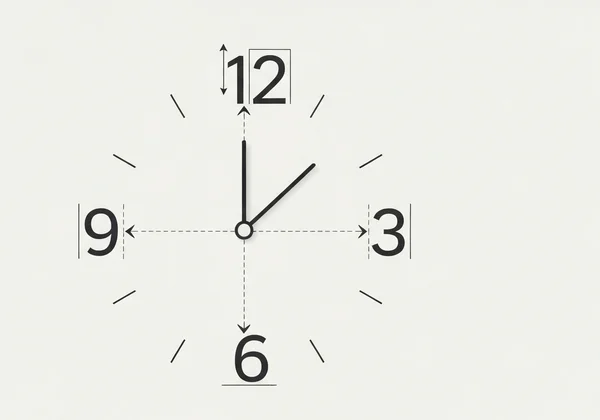
An analog clock is a perfect miniature map of spatial relationships. A child learns that the '12' is at the top, the '6' is at the bottom, and the '3' and '9' are on the sides. They begin to understand concepts like clockwise, counter-clockwise, and angles in a playful way.
When a child sees the minute hand pointing to the '3', they learn it represents 15 minutes past the hour. This isn't just memorization; it’s a fun mental game of understanding parts within a whole. They are visually processing angles and positions, connecting them to numbers. This constant practice of interpreting the position of the hands helps build a strong internal sense of space and direction.
Research-Backed Benefits of Spatial Tasks for Academic Success
Research shows that strong spatial skills lead to success in science, technology, engineering, and math. Reading a clock face gives children's brains exactly this kind of exercise.
For example, understanding that the clock is a circle of 360 degrees lays the groundwork for geometry. Seeing the space between the numbers as increments of five minutes helps with visualizing number lines and multiplication. These aren't just abstract ideas; they are tangible concepts that a child can see and even manipulate. By engaging in spatial tasks like reading a clock, children are training their brains for more complex academic challenges ahead.
The Hidden Math Connection: Fractions Through Clock Learning
At first glance, a clock tells time. But look closer, and you'll see it’s also a visual introduction to some of math’s most important concepts, especially fractions. For many children, fractions can be abstract and confusing. An analog clock makes them concrete and easy to grasp.
Clock Faces as Visual Fraction Models
A clock face is a natural, real-world fraction model that children encounter daily. It’s divided into clear segments that make the idea of parts of a whole feel intuitive and fun.
- Halves and Quarters: When the minute hand is at the '6', it's "half past" the hour. This is a child's first, practical introduction to the fraction 1/2. Similarly, "a quarter past" (the '3') and "a quarter to" (the '9') introduce them to 1/4 and 3/4.
- Twelfths and Sixtieths: The clock is divided into 12 hours and 60 minutes. Each number represents 1/12 of the clock, and each minute mark represents 1/60. While a child might not use this terminology at first, they are internalizing the concept of dividing a whole into smaller, equal parts.
This hands-on experience with fractions is invaluable. It transforms a tricky mathematical idea into a simple, visual puzzle. You can help your child explore these concepts with an interactive learning clock that lets them move the hands and see the relationships for themselves.

How Minute Hand Movement Builds Number Sense
Number sense is the intuitive understanding of numbers and how they relate to each other. The movement of the minute hand is a fantastic tool for building this skill. Children learn to count by fives (5, 10, 15, 20...) as they track the minute hand around the clock.
This isn't just rote counting. It helps them understand skip-counting, a foundational skill for multiplication and division. They see that moving from the '2' to the '4' is a jump of 10 minutes. This dynamic counting strengthens their mental number line and their ability to perform mental math calculations more quickly and confidently.
Executive Function Skills Developed Through Clock Practice
Executive functions are the mental skills that help us plan, focus, and multitask. Practicing with an analog clock is a surprisingly effective way to strengthen these core abilities in your child.
Planning and Time Management Foundations
An analog clock gives children a visual picture of time passing. Unlike a digital display that just shows a single moment, an analog clock shows the past, present, and future. A child can see that it's 3:15, and they can also see the distance the minute hand has to travel to reach 3:30.
This visual map of time is the first step toward building planning and time management skills. It helps a child answer questions like, "How much time do I have left to play before dinner?" They begin to feel the duration of five minutes or half an hour, rather than just hearing the words. This concrete understanding of time's flow is essential for learning to organize tasks and manage schedules later in life. Give your child a head start by letting them practice with our clock today.

Working Memory Enhancement Through Sequential Learning
Reading an analog clock requires holding and processing multiple pieces of information at once, which is a great workout for a child's working memory.
Reading a clock involves several steps. First, find the hour hand (the short, blue one) and see what number it just passed. Next, find the minute hand (the long, red one), multiply its number by five, and then combine both pieces to say the time.
For a young learner, this is a complex mental task. They have to remember the function of each hand, recall the counting-by-fives rule, and then put it all together. With practice, this sequence becomes automatic. This process of holding, manipulating, and recalling information strengthens the working memory "muscle," which is crucial for everything from following multi-step instructions to solving math problems.
Beyond Time-Telling: The Lifelong Cognitive Benefits of Analog Clocks
Teaching a child to read an analog clock does more than just teach time. It helps their brain develop in many ways. This hands-on experience builds skills they'll use throughout their life. From enhancing spatial reasoning and mathematical understanding to strengthening executive function skills, the humble clock face is a powerful educational tool.
When kids use analog clocks instead of digital screens, they're using their hands and eyes to learn in a way that tablets and phones can't match. It encourages children to think critically about relationships, patterns, and the passage of time in a tangible way. By embracing this classic skill, you are giving your child a set of mental tools that will serve them well in school and beyond.
Ready to put these benefits into practice? The best way for children to learn is by doing. Explore our fun, interactive analog clock online and watch your child’s confidence and skills grow as they play.
The Takeaway
Why are analog clocks still taught in school?
Schools continue to teach analog clocks because it helps develop crucial cognitive skills. It improves spatial reasoning, strengthens number sense through counting by fives, and introduces concepts like fractions in a visual way. It turns tricky ideas into something kids can actually see and understand.
What age should a child be able to read an analog clock?
Most children are developmentally ready to start learning between the ages of 5 and 7. They typically begin by learning to tell time to the hour and half-hour. By age 8, most can read a clock to the nearest minute. Every child learns at their own pace, and using a fun, interactive clock can make the process easier.
How do analog clocks help with brain development?
Analog clocks support brain development by engaging multiple cognitive functions simultaneously. They require a child to use spatial awareness to interpret the hands' positions, mathematical skills to calculate minutes, and working memory to combine the information into a single time. Putting all these ideas together helps build stronger connections in your child's growing brain.
Are analog clocks better for learning than digital clocks?
For learning about the concept of time, analog clocks are often better. They provide a visual representation of time's passage and its cyclical nature. A child can "see" how much time is left until an event. Digital clocks are excellent for quick, precise readings, but they don't offer the same rich, conceptual learning experience.
What cognitive skills does learning time on an analog clock develop?
Learning to tell time on an analog clock primarily develops three key areas:
- Spatial Reasoning: Understanding angles, positions, and orientation.
- Mathematical Skills: Learning fractions (halves, quarters) and skip-counting (by fives).
- Executive Function: Improving working memory, planning, and sequential thinking.